


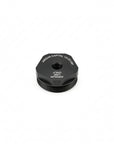
Falcon – 1.25"×5" Airgun Suppressor
Your build
Falcon – 1.25"×5" Airgun Suppressor
The Falcon is our compact airgun suppressor — also called an airgun moderator, airgun silencer, or LDC (lead dust collector), depending on where you're from and who you ask. It's CNC-machined from 6061-T6 aluminum, hard anodized matte black, and built to the exact caliber and thread pitch of your rifle. No adapter required. No oversized exit bore. It ships matched to your platform and ready to thread on.
Do not let the size fool you. The Falcon runs a five-baffle stack in our slimmest body and the suppression is serious. It's built for shooters who want that performance without weight hanging off the muzzle: PCP plinking rifles, springers, CO2 pistols, field target setups, and small-game hunting builds.
Caliber Range
The Falcon handles .177, .22, .25, and .30 caliber air rifles and pistols. Every Falcon ships with a caliber-matched front endcap — the exit bore is sized within roughly 1mm of your projectile, so you're not losing suppression to an oversized hole the way you do with one-size-fits-all moderators.
Thread Options
The Falcon is available in four thread pitches, covering the vast majority of threaded airguns sold in the US and abroad:
- 1/2-20 UNF — the most common thread on US-market airguns.
- M14×1.25 — a common European metric thread.
- M18×1 — used on a variety of higher-power and large-bore platforms.
- M20×1 — found on several premium European airguns.
If your rifle uses a different thread, browse our adapter collection — or email us at admin@airguncapital.com and we'll confirm fitment for your exact platform before you order.
Construction
- CNC-machined 6061-T6 aluminum
- Matte black hard-anodized finish
- 5-baffle internal stack, caliber-specific
- Caliber-matched front endcap
- Threaded base cap, matched to your rifle's pitch
- Removable baffles, full disassembly without tools
Sound Reduction
Significant reduction in muzzle report across most airgun platforms. Actual results vary by rifle, caliber, FPE, and shroud configuration.
Buy now — ships same or next business day from Miami, FL.
Designed by a family-operated business in Miami, FL. Airgun not included.
What size should I get?
Functionally, nothing. They're four names for the same product: a tube with internal baffles that reduces the muzzle report of an air rifle or air pistol. The terminology splits along regional and generational lines. Airgun suppressor is the most common term in the United States. Airgun moderator is more common in the UK, Europe, and Australia. LDC — short for lead dust collector or lead deposit collector — is older airgun-specific terminology, still used by some shooters who learned the hobby in the 80s and 90s. Airgun silencer is the most casual of the four and is generally used interchangeably. Whatever you call it, every product on this page does the same job. The only meaningful differences across the lineup are size, internal volume, caliber range, and thread pitch — not what you call it.
No. Airgun suppressors sold for legitimate airgun use are not regulated under the National Firearms Act. There is no tax stamp, no Form 4, no fingerprinting, no waiting period, and no federal background check. Each unit is assembled to order and ships directly to your address, typically within a few business days. That said, suppressor laws are not federal-only — some states, counties, and cities restrict or prohibit civilian suppressor ownership regardless of whether the host is a firearm or an airgun. We ship to all 50 states, so it remains the buyer's responsibility to confirm that an airgun suppressor is legal at their delivery address — in their state, county, and city — before placing an order.
Match the suppressor to your largest intended caliber, then size up if you want maximum suppression. The Falcon (1.25"×5") is the slimmest and lightest unit in our standard lineup and covers .177 through .30 — it's the right call for plinkers, springers, CO2 pistols, and field-target setups. The Hawk (2"×4.5") is the all-rounder, packing a full 2-inch internal volume into a compact 4.5" body and handling everything from .177 up through .357. The Eagle (2"×8") is the flagship and the only unit in the lineup that handles full big-bore — .45 and .50 caliber included. As a general rule: more internal volume means more suppression. If your rifle handles the weight and length, sizing up is always the quieter choice.
Most airguns sold in the United States ship with a 1/2-20 UNF muzzle thread — by far the most common pitch in the country, and the default thread on Airgun Capital's full lineup. 1/2-28 UNEF is a firearms-pattern thread that shows up on some cross-platform airguns and on a small number of US-market rifles. M14×1.25 is the most common European metric thread and appears on a wide range of European-built rifles. M18×1 is the standard for higher-power and large-bore platforms — most rifles chambered in .357, .45, and .50 caliber use M18×1. M20×1 is found on several premium European rifles. If your rifle's thread pitch isn't listed in the user manual, check the muzzle stamp or measure the thread directly. If you're still unsure, email support@airguncapital.com with your rifle make and model and we'll confirm fitment before you order.
Adding any muzzle device — suppressor, brake, or shroud extension — changes the harmonic signature of your barrel, and that change can shift your point of impact slightly when you first thread the unit on. The shift is usually small, predictable, and easily corrected with a few clicks of windage and elevation on your scope. Once you're re-zeroed, accuracy at distance is unaffected. The one place where a poorly-built suppressor hurts accuracy is pellet clipping — when the projectile catches the inside of an off-center baffle or an oversized endcap on its way out. Every Airgun Capital suppressor is built around precision baffle stacks and a caliber-matched front endcap (the exit bore is sized within roughly 1mm of your projectile diameter), which is what we mean when we say no clipping. Re-zero after install, shoot a group at your usual range, and the rifle will print exactly where you ask it to.
Disassemble and clean every few thousand rounds, or sooner if you're shooting heavy lead loads. Every Airgun Capital suppressor comes apart by hand — unscrew the threaded front endcap, slide out the baffle stack, and inspect each baffle for lead buildup. For light cleaning, a nylon brush and a clean rag are usually enough. For heavier buildup, a sonic cleaner is the gold standard, or you can soak the baffles in a mild solvent like Ballistol or a dedicated lead-removal product. Avoid harsh solvents — anything aggressive enough to strip oxidation will also strip the anodized finish and the internal aluminum. Dry each baffle fully before reassembly, check that nothing is bent or out of round, and thread the endcap back on hand-tight. The whole process takes under five minutes once you've done it once.